Budget 2027 for SMEs in Malaysia: tax cut, minimum wage and grants explained
The short version
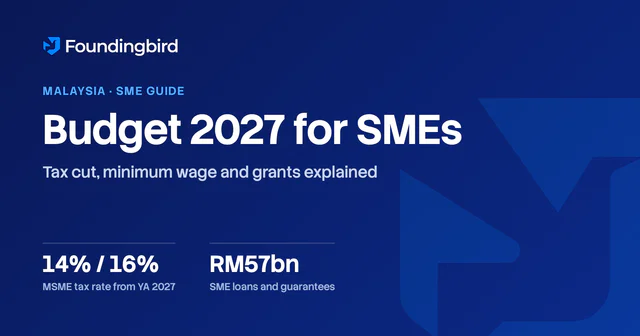
- Lower tax: the MSME rate drops from 15% to 14% on your first RM150,000 of profit, and from 17% to 16% on RM150,001–RM600,000, from YA 2027. That's up to RM6,000 a year back in your pocket.
- Minimum wage: it goes up to RM2,000 in June 2027, but MSMEs with annual sales below RM50 million are exempted.
- More financing: loans and guarantees grow from RM50 billion to RM57 billion in 2027.
- Grants: a RM30 million MDEC fund for AI and automation, and up to RM5,000 towards your first halal certification.
- E-invoicing: nothing new. And remember, all of this is still a proposal until the Finance Bill is passed.
If you run a small company in Malaysia, two questions probably popped into your head when Budget 2027 was tabled on 9 October: will I pay less tax, and do I have to raise salaries to RM2,000? The short answers: yes, a little. And probably not, if your annual sales are below RM50 million.
There's quite a bit more in there for founders, from bigger loan guarantees to grants for AI and halal certification. I've gone through the speech and the tax documents and pulled out what matters for a typical Sdn Bhd, plus a few things you can already start doing.
The main changes for SMEs, in one table
If you only have a minute, start here.
| What's changing | Who it's for | How much | From when |
|---|---|---|---|
| Lower MSME tax rate | MSMEs (see the test below) | 14% / 16% | YA 2027 |
| Minimum wage exemption | MSMEs with annual sales below RM50m | RM2,000 not required | June 2027 |
| MediAsas premium subsidy | SMEs with fewer than 75 staff | RM200 per employee | January 2027 |
| SJPP and CGC guarantees | SMEs and mid-tier companies | Up to RM32bn | 2027 |
| MDEC AI fund | MSMEs | RM30m for 4,000 MSMEs | Details to come |
| Halal grant | MSMEs getting certified for the first time | Up to RM5,000 | Details to come |
Your tax bill: what changes
The MSME rate drops by one percentage point
This is the headline for most founders. The two lower bands each go down by one point from YA 2027:
| Chargeable income | Today | From YA 2027 |
|---|---|---|
| First RM150,000 | 15% | 14% |
| RM150,001 to RM600,000 | 17% | 16% |
| Above RM600,000 | 24% | 24% |
Quick definitions: chargeable income is your profit after allowable expenses and capital allowances, and YA stands for year of assessment.
The Government says this puts up to RM6,000 back into the hands of 300,000 MSMEs. To see where that number comes from, take a company with RM600,000 of chargeable income. Today it pays RM99,000 (15% of RM150,000 plus 17% of RM450,000). Under the new rates, it would pay RM93,000. That's RM6,000 saved. (This is just an illustration; your own numbers will differ.)
Do you count as an MSME?
Under the current rules, you do if your company has paid-up ordinary share capital of RM2.5 million or less (or, for an LLP, capital contributions of RM2.5 million or less) and annual sales of no more than RM50 million. Got foreign shareholders, or part of a group? Then it's worth a quick chat with your tax agent before you count on the lower rate.
Not sure your paid-up capital and shareholding are recorded correctly with SSM? Our digital company secretary can check that for you.
Buying laptops and equipment gets a little easier
From YA 2027, you can fully claim small assets costing up to RM3,000 each, up from RM2,000. MSMEs already have no overall annual cap on these claims. For other companies, the cap goes up from RM20,000 to RM30,000. So that new laptop or coffee machine for the office could be written off in the year you buy it.
The accelerated capital allowance has also been extended to 31 December 2030. It covers locally produced plant and machinery, as well as ICT equipment and software.
A few smaller tax changes
- Pay salaries by bank transfer: from YA 2028, companies can only deduct salaries paid through banks or approved cashless channels. MSMEs are exempted, but paying by transfer is a good habit anyway.
- Your own tax: if you pay yourself a salary, individual relief goes up from RM9,000 to RM12,000, and the rate on income between RM70,001 and RM100,000 drops from 19% to 18%. Our guide to taxes for Sdn Bhd companies covers the basics.
- Cheaper paperwork on financing: stamp duty is just RM10 on P2P loans and on supplier financing that lets mid-tier companies pay their MSME suppliers early, from 2027 to 2030. Opening a savings or current account will be free of stamp duty from 1 January 2027.
- Sales tax refund: from 1 January 2027, traders who supply machinery, equipment and certain inputs to manufacturers can claim back the sales tax they paid.
Do you have to pay the RM2,000 minimum wage?
What's been announced
The minimum wage goes up from RM1,700 to RM2,000 in June 2027. The good news for smaller companies is that MSMEs with annual sales below RM50 million will be exempted, which the speech says is "to provide room for adjustment to business models". On top of that, the Government plans a RM2,500 monthly minimum wage for semi-skilled workers and graduates.
What we don't know yet
The fine print still isn't out. We don't yet know how "annual sales" will be measured, how group companies will be treated or how long the exemption lasts. There's also no start date for the RM2,500 rate, and no word on whether the exemption applies to it.
What I'd do in the meantime
Plan for both outcomes until the official order is published. And even if you're exempted, keep in mind that you're hiring from the same pool as companies that will be paying more.
Payroll and hiring
MediAsas: RM200 per employee if you have fewer than 75 staff
MediAsas, a new medical scheme, launches in January 2027. If your company has fewer than 75 employees, the Government will cover RM200 of each employee's first-year premium, for up to 50 employees. Staff under 55 can also pay their premiums from their EPF Sejahtera Account.
Tax deductions for looking after your team
- PTPTN: if you repay a full-time employee's PTPTN loan between 1 January 2027 and 31 December 2028, you can deduct it. This doesn't apply to owners or family members.
- Bakat MADANI: companies that run Bakat MADANI training programmes get a tax deduction from 29 June 2026 to 31 December 2030.
Our HR & payroll service, delivered together with our sister company Ollie, takes care of payroll and your EPF, SOCSO and EIS submissions. New to all this? Start with our guide on EPF, SOCSO and EIS contributions.
More money to borrow: RM57 billion in loans and guarantees
In total, loan facilities and financing guarantees grow from RM50 billion to RM57 billion in 2027. Here's where it's coming from.
SJPP and CGC guarantees
Syarikat Jaminan Pembiayaan Perniagaan (SJPP) and Credit Guarantee Corporation (CGC) will guarantee up to RM32 billion of financing. In plain terms, they cover part of your bank loan, so the bank is willing to lend with less collateral. SJPP's guarantee limit goes up to RM50 million, and RM1 billion is set aside for local companies growing through mergers and acquisitions.
Bank Negara, BPMB and MATRADE
- Bank Negara Malaysia is adding another RM5 billion to its existing RM5 billion facility for SMEs hit by the West Asia conflict.
- If you're looking to export, BPMB has RM1 billion in financing for MSMEs, and MATRADE gets RM60 million to help companies break into new overseas markets.
Microfinancing for smaller businesses
Microfinancing goes up to RM6.6 billion in total:
- RM3 billion through AIM, for 360,000 entrepreneurs
- RM1.3 billion through TEKUN, with a focus on Bumiputera entrepreneurs
- RM150 million for Indian entrepreneurs through TEKUN and AIM
- RM1.7 billion through BSN
Bumiputera financing
PUNB's financing grows from RM350 million to RM500 million, and TERAJU will offer financing of up to RM1 billion.
Grants for SMEs and startups
Help with AI and automation
MDEC is getting RM30 million to help 4,000 MSMEs adopt AI and automate their operations. Who can apply and when hasn't been announced yet.
Halal certification
If you're getting halal certified for the first time, there's a matching grant of up to RM5,000. Halal MSMEs in sectors like cosmetics and pharmaceuticals can also get a RM25,000 grant.
If you're building a startup
- Cradle Fund gets RM41 million, including grants for prototypes and commercialisation.
- Tax incentives for angel investors and individual ECF investors are extended to 31 December 2030.
- RM270 million is set aside to bring more private money in through ECF and P2P platforms.
- Jelawang Capital and Dana Perintis will put RM450 million into startups.
- A new RM50 million UniVC Fund will help take university research to market.
Equipment grants and rent support
The Sejahtera MADANI grants (RM200 million) will help 40,000 people, particularly women, buy equipment and get training. And more than 10,000 small traders renting DBKL premises will get 50% off their rent throughout 2027.
E-invoicing, AI and e-commerce
Nothing changes for e-invoicing, so keep following the current LHDN rules. A couple of related announcements:
- An E-Commerce Bill will be tabled at the next Parliament sitting, aimed at protecting local MSMEs from unfair competition from foreign e-commerce companies.
- NADI gets RM142 million to help young entrepreneurs sell online, and JOM Malaysia gets RM10 million to bring rural products onto digital platforms.
If you're a foreign founder
- From 1 January 2027, spouses of Category I Employment Pass holders on a Dependant Pass will be allowed to work, subject to conditions.
- DE Rantau Nomad Pass holders who hit the two-year limit will be able to keep staying and working remotely, subject to criteria.
- Listed companies with the new MyABE status will get a five-working-day target for initial Employment Pass applications.
Thinking about moving here to run your company? Our guide on work visa options for foreign entrepreneurs walks you through the options.
A few things for specific industries
- Tourism and events: RM935 million for tourism and culture, including grants for tourism events, plus rebates for organisers at venues with 10,000+ capacity.
- Planning to list: matching grants for companies listing in both Malaysia and Hong Kong.
- Agriculture: more than RM1 billion in financing for agropreneurs.
- Elderly care: service tax drops from 8% to 6%.
- Green technology: the enhanced green investment tax allowance (GITA) for qualifying green assets runs until 2030.
What you can do now
This month
- Check your paid-up capital and annual sales against the MSME test, and make sure your SSM records are up to date. Our compliance checklist helps.
Before 31 December 2026
- Plan any purchases of small assets (up to RM3,000 each), machinery or ICT equipment. Whether it's better to buy before or after 1 January 2027 is something to confirm with your tax adviser.
- If you still pay any salaries in cash, switch to bank transfer.
Before June 2027
- Once the criteria are out, work out where you stand on the minimum wage. If you have fewer than 75 staff, look into MediAsas.
When you file for YA 2027
- Claim the new rates and allowances, and keep your accounts ready in case you apply for financing.
FAQ
What's the SME tax rate under Budget 2027? From YA 2027, MSMEs are set to pay 14% on the first RM150,000 of chargeable income (down from 15%), 16% on RM150,001 to RM600,000 (down from 17%), and 24% on anything above that.
How much will my company actually save? Up to RM6,000 a year. For example, a company with RM600,000 of chargeable income would pay RM93,000 instead of RM99,000. If your profit is lower, your saving will be smaller too.
Do SMEs have to pay the new RM2,000 minimum wage? Not if you're an MSME with annual sales below RM50 million. You'll be exempted when the RM2,000 minimum wage starts in June 2027. The detailed criteria aren't out yet, so plan for both outcomes until the minimum wage order is published.
Does my company count as an MSME for the lower tax rate? Right now, an MSME is a company with paid-up ordinary share capital of RM2.5 million or less and annual sales of no more than RM50 million. If you have foreign shareholders or you're part of a group, check with your tax agent.
Has anything changed for e-invoicing? No. Neither the Budget 2027 speech nor the Tax Measures mentions e-invoicing, so the current LHDN rules still apply.
Is there a grant for going digital or using AI? Yes. A RM30 million MDEC fund will help 4,000 MSMEs adopt AI and automate their operations. MDEC hasn't shared how to apply yet.
Budget 2027 gives SMEs some room to breathe, but you can only make the most of it if your records, accounts and payroll are in order. If you're planning to incorporate a Sdn Bhd in 2027, or just want a hand with your filings, have a look at how our digital company secretary services work. For bookkeeping, our sister company Ollie offers AI-native accounting from RM300/month (excl. SST). Got questions? WhatsApp us.
Sources: everything in this article comes from the official Budget 2027 speech and the Budget 2027 Tax Measures from the Ministry of Finance, both published on 9 October 2026. These are still proposals until the Finance Bill is passed and gazetted, and we'll update this article when that happens. This is general information, not tax or legal advice. Last updated: 11 October 2026.
About the author: Dylan Damsma is the founder of Foundingbird, which has helped 2,000+ founders start and run their companies in Malaysia.

SSM-licensed company secretary
Your company secretary, without the waiting
Quick replies on WhatsApp, every document in one client portal, and reminders before each SSM deadline.
Billed yearly: RM1,188 or RM1,980, excl. SST.
Table of Contents
We're the most convenient online platform for starting & managing a Sdn Bhd
- Incorporation of Sdn Bhd
- Company secretary
- Accounting & Bookkeeping
- Audit & Taxation
- HR & Payroll